Beyond lift and shift: A strategic approach to on-premises to Azure modernization
October 12, 2026
For many enterprises, the datacenter remains deeply embedded in the technology landscape. Core applications, databases, virtual machines and business-critical workloads may have accumulated over years, supported by infrastructure that was designed for a different era of scale and operating models.
Yet the demands placed on enterprise technology have changed. Organizations are expected to scale faster, respond to market shifts, strengthen resilience, enable data-driven decision-making and create an architecture capable of supporting AI and modern digital services. This is where Microsoft Azure enters the conversation.
But moving from on-premises infrastructure to Microsoft Azure is not simply a matter of relocating workloads. A successful on-premises to Azure migration requires organizations to determine what should move, what should be modernized, what should remain, and how the resulting environment should be governed and operated.
The objective is not to reproduce the datacenter in the cloud.
It is to create a more resilient, scalable and strategically aligned technology foundation.
Establishing the case for cloud modernization
The traditional infrastructure model requires organizations to anticipate capacity, procure hardware, maintain datacenters and manage infrastructure throughout its lifecycle. As workloads become more dynamic, these requirements can constrain the pace at which technology teams respond to the business.
Microsoft Azure provides an alternative operating model, with services spanning infrastructure, platforms, databases, analytics, AI, security and application modernization.
The value, however, extends beyond infrastructure.
Consider a retailer preparing for seasonal demand. An on-premises environment may require infrastructure to be provisioned well ahead of a peak period, even though that capacity may remain underutilized for much of the year. A cloud architecture can provide greater elasticity around changing demand.
Similarly, an enterprise running a legacy database may find that simply moving the database to an Azure virtual machine changes its location but not its operational burden. Replatforming that database to an Azure-managed service, where appropriate, can reduce infrastructure administration while creating a stronger foundation for resilience and modernization.
These distinctions matter because cloud migration is ultimately an operating-model decision, not merely an infrastructure decision.
From infrastructure inventory to cloud readiness
The first step in an Azure migration should be establishing a reliable view of the existing technology estate.
Enterprises often discover that the apparent simplicity of their infrastructure masks a complex web of dependencies. A single application may rely on several databases, authentication services, file systems, APIs and network connections. Moving one component without understanding those relationships can create performance issues or disrupt business processes.
Tools such as Azure Migrate can help organizations discover workloads, assess readiness, understand dependencies and inform migration planning.
The resulting assessment should establish:
- Which workloads are business-critical
- Which applications and databases are interdependent
- Current utilization and performance requirements
- Security and compliance constraints
- Existing infrastructure and licensing costs
- Technical debt and unsupported technologies
- Recovery and availability requirements
- Opportunities for application and database modernization
This creates a more consequential question than “What can we migrate?”
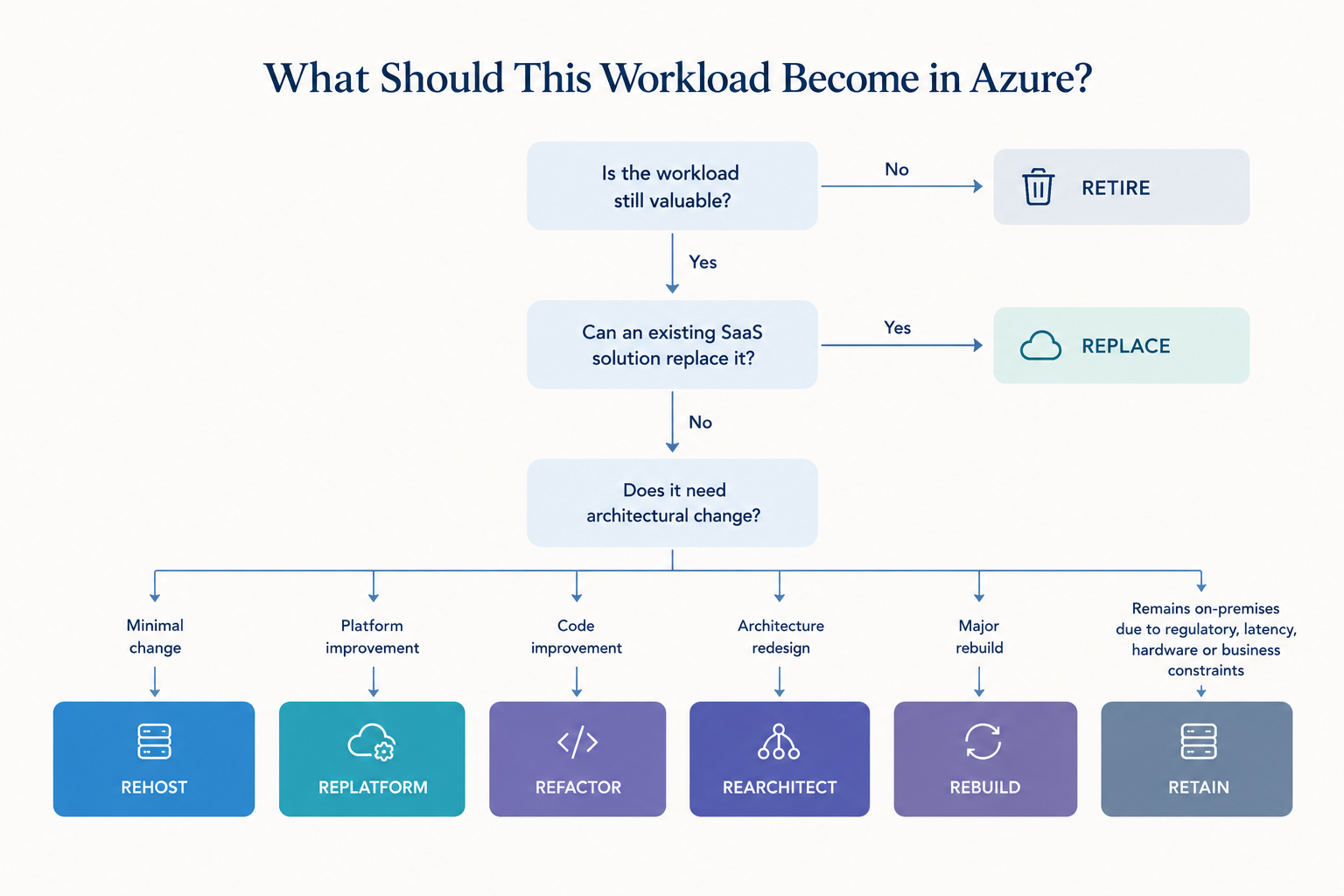
The question becomes: “What should this workload become in Azure?”
Defining the right modernization path for every workload
There is no universal migration strategy for an enterprise estate.
Microsoft's Cloud Adoption Framework identifies a range of approaches, including retire, retain, rehost, replatform, refactor, rearchitect, rebuild and replace. The appropriate choice depends on the workload's business value, technical condition, desired outcome and constraints.
Rehost: when continuity is the priority
Rehosting moves a workload to Azure with minimal changes.
For example, a stable internal application running on a Windows Server virtual machine may be migrated to an Azure Virtual Machine when the immediate objective is to reduce datacenter dependency without undertaking application redevelopment.
This can provide a relatively direct migration path. But it should not become a default strategy. Microsoft notes that rehosting does not resolve existing performance, reliability or architectural issues.
Replatform: when the workload can benefit from managed services
Replatforming introduces Azure platform services with limited application modification.
Consider a SQL Server workload currently operating on a dedicated virtual machine. Moving it to an appropriate Azure SQL service can reduce the infrastructure management burden while providing a more modern platform for the application.
The workload remains familiar to users, but its underlying operating model becomes more efficient.
Refactor or rearchitect: when modernization is the objective
Some applications carry years of technical debt. They may be difficult to scale, expensive to maintain or constrained by tightly coupled architecture.
Refactoring can improve the codebase and its maintainability, while rearchitecting can fundamentally change how components interact. For example, a monolithic application might be decomposed into services that can scale independently.
These approaches require greater investment, but they can unlock capabilities that a straightforward infrastructure migration cannot.
Retire or replace: when migration is not the answer
A migration assessment may also reveal applications that no longer provide sufficient business value to justify continued investment.
Others may be better replaced with a SaaS solution rather than recreated in Azure.
This is an important principle of cloud adoption: not every workload deserves a migration plan.
Establishing the Azure foundation for enterprise scale
Workload migration should not begin before the target environment is appropriately designed.
An Azure landing zone establishes the architectural and operational foundation for enterprise cloud adoption, covering areas such as identity, networking, governance, security, monitoring and management. Microsoft's guidance specifically recommends preparing the landing zone before workload migration.
For organizations operating in hybrid environments, this foundation is particularly important.
An enterprise may have its identity infrastructure on-premises, applications in Azure and certain regulated workloads remaining in a datacenter. Connectivity between these environments therefore becomes part of the target architecture rather than a temporary workaround.
A well-designed foundation provides the governance and connectivity required to make this transition deliberate rather than fragmented.
Orchestrating migration around business-critical dependencies
Enterprise migration should be treated as a sequence of controlled decisions rather than a single cutover.
Workloads can be grouped into migration waves according to business criticality, dependencies, technical complexity and readiness. Microsoft's migration guidance emphasizes determining migration sequence, method and rollback planning before execution.
A practical sequence might begin with discovery and assessment, followed by preparation, pilot migration, validation and progressively larger migration waves.
For example, an organization could begin with a lower-risk application that shares networking and identity patterns with more critical workloads. The pilot becomes an opportunity to validate connectivity, monitoring, security controls, backup, operational procedures and cost assumptions.
Lessons from that wave can then inform the migration of more complex applications.
This approach turns migration from a one-time technology event into a repeatable enterprise capability.
Embedding security and governance across the cloud lifecycle
Security cannot be retrofitted effectively after migration.
Identity, access controls, network security, data protection, monitoring and governance need to be incorporated into the Azure architecture from the outset.
This is particularly relevant for enterprises operating across multiple business units or geographies, where inconsistent resource configurations can introduce unnecessary operational and compliance complexity.
Governance should also extend to cloud economics. Resource utilization, consumption patterns, licensing, reservations and application performance all influence the economics of an Azure environment.
The result should be an environment in which security, governance and cost management are architectural disciplines rather than post-migration controls.
Engineering for continuity across hybrid environments
For many enterprises, the journey to Azure will not be immediate or absolute.
Certain workloads may remain on-premises because of regulatory requirements, latency considerations, hardware dependencies or business priorities. Others may migrate only after their applications have been modernized.
This makes hybrid architecture an important part of the transition.
Connectivity between on-premises environments and Azure must account for application dependencies, identity, DNS, routing, data movement and security. Azure's landing-zone guidance includes hybrid connectivity, identity, DNS, routing and monitoring among the considerations for migration readiness.
The goal is not simply to connect two environments. It is to create an operating model in which workloads can function securely and reliably across both while the enterprise progresses toward its intended target architecture.
Turning migration into continuous cloud optimization
The migration does not end when the final workload goes live. In fact, that is where the next phase begins.
Once workloads operate in Azure, organizations can assess whether applications are appropriately sized, whether platform services can replace infrastructure components, whether deployment processes can be automated and whether additional modernization can improve performance or resilience.
This is where practices such as CloudOps, DevSecOps and FinOps become increasingly important.
An application initially rehosted for speed may later be replatformed. A database may move to a managed service. Infrastructure provisioning may become automated through infrastructure as code. Monitoring can evolve from basic infrastructure visibility to application-level observability.
Microsoft's modernization guidance recognizes replatforming, refactoring and rearchitecting as distinct approaches for extracting greater value from workloads after or during migration.
The cloud environment therefore becomes a platform for continuous improvement rather than a destination reached once.
DISCOVER
Understand your technology estate
↓
ASSESS
Map dependencies, risks and readiness
↓
DESIGN
Build the Azure foundation
↓
MIGRATE
Move workloads in controlled waves
↓
MODERNIZE
Replatform, refactor and rearchitect where it matters
↓
OPTIMIZE
Embed CloudOps, DevSecOps and FinOps
Measuring migration by business outcomes, not workloads moved
The number of workloads migrated is an incomplete measure of success.
A more meaningful assessment considers what has changed for the enterprise.
Has infrastructure become easier to scale?
Has operational overhead decreased?
Have recovery capabilities improved?
Can development teams release applications more efficiently?
Has technical debt been reduced?
Can the organization establish a stronger foundation for data, analytics and AI?
And, critically, can the technology environment adapt as business requirements evolve?
These are the outcomes that distinguish cloud migration from cloud modernization.
From cloud migration to enterprise modernization
Systems Limited approaches Microsoft Azure migration as part of a broader modernization journey.
Our Microsoft Azure capabilities span cloud strategy, migration and modernization, application modernization, security, DevSecOps, managed cloud services and FinOps, enabling organizations to address both the technology transition and the operating model that follows it.
Backed by more than 2,000 Azure certifications and a long-standing Microsoft partnership, we bring Azure expertise together with capabilities across Microsoft data, AI, business applications and security.
This breadth matters because enterprise modernization rarely stops at infrastructure. An Azure migration can become the foundation for modern applications, unified data environments, intelligent automation and AI-enabled business processes.
The strategic question, therefore, is not simply whether an organization should move its workloads from on-premises infrastructure to Azure. It is whether the migration can be used to reconsider the architecture, operating model and capabilities that will support the enterprise for the years ahead. That is the difference between moving to the cloud and modernizing for the cloud.
Planning your move to Azure? Partner with Systems Limited to turn migration into modernization.
Quick Link
You may like



How can we help you?
Are you ready to push boundaries and explore new frontiers of innovation?